
How to Check Criminal History in Edgefield
An Edgefield criminal records search works best when the record type is named at the start. A town officer's report stays with the municipal agency. Edgefield County Detention answers current custody questions. Magistrate or Municipal Court holds an assigned summary matter, while the Clerk of Court keeps General Sessions filings. Permanent historic material may have moved to County Archives. These channels sit near one another, but their files are not interchangeable.
Follow the event in order and preserve the identifiers found at each stop.
- Identify whether Edgefield town police, the county sheriff, or another agency handled the event.
- Request the incident or arrest report from that creating agency with the date, place, and incident number.
- Check the issuing summary court for a local citation or lower-level charge.
- Search Edgefield Public Index and contact the Clerk for General Sessions records or certified copies.
- Compare the court trail with SLED CATCH when a statewide South Carolina history is needed.
Edgefield's Two Record Districts
Modern Edgefield record access follows a two-address pattern. The Clerk of Court and SCDPPPS are at 129 Courthouse Square. County Archives and administration are at or near 124 Courthouse Square. Sheriff, detention, and Magistrate Court functions are at 264 Star Road. Choosing between those clusters depends on the item, not on which building seems most official.
Use Courthouse Square for filed General Sessions records, certified court copies, supervision questions, and permanent archives. Use Star Road for sheriff-created reports, present detention status, and county Magistrate matters. An Edgefield town police narrative remains a municipal record, even when a person later passes through the county jail. Calling ahead matters because unpublished details include records-counter hours, copy and certification fees, identification rules, and turnaround.
The Edgefield Police Department
Edgefield town police create reports for events their officers handle. The research did not locate an official municipal records form, portal field inventory, counter schedule, fee table, or verified direct records contact. Do not substitute the Edgefield County Sheriff or Magistrate Court as the town police records desk. Confirm the current municipal request route before sending personal information or payment.
A focused request should identify the incident or report number when known, approximate date and time, exact location, requester's contact and role, requested report or media, and preferred delivery format. Ask separately for dispatch audio, video, photographs, or crash material. The town may redact active investigative details, juvenile information, protected identities, medical facts, and other exempt data. If the agency says no report exists, verify which department responded before widening the search.
Edgefield Report and Booking Split
One Edgefield arrest can create several records at once. The arresting officer writes an agency report. County detention creates the booking record. A prosecutor selects the filed charge, and a clerk builds the docket. SLED receives fingerprint-supported arrest information and later reported dispositions. A charge at arrest can differ from the prosecuted charge or offense of conviction.
Ask each custodian for its own item. A sheriff response cannot supply a complete town-police narrative merely because county staff booked the person. The town report cannot certify the final General Sessions disposition. The Public Index may show court events but not all attachments or narrative facts. This split is not a defect in the Edgefield system. It reflects who created and maintains each public record.
Arrests and Bookings in Edgefield
Edgefield County has no official online inmate roster. For current detention custody, call 803-637-4124. Ask whether the person is presently held, what public booking identifier is available, and which court or agency controls the case. That call does not provide a complete criminal history or final court result. Custody can change during the day.
A missing jail result does not prove release or the absence of an arrest. The person may have bonded out, transferred, entered another county's custody, moved to state or federal prison, or been released while the case remains open. Request historic booking material from the detention or sheriff records channel. Request the arrest narrative from the agency that made the arrest. The full county Edgefield arrest history covers those broader routes.
Edgefield's 1785 Criminal Records
Edgefield County dates to 1785, and its archive trail is unusually deep. County Archives preserves permanent material under a County Council resolution adopted in 2001. The South Carolina Archives guide lists General Sessions, Magistrate, and sheriff jail books among the county holdings. That makes Edgefield useful for genealogy and historical court research as well as current record access.
The official South Carolina Archives county-record guide shows the scope of preserved holdings.
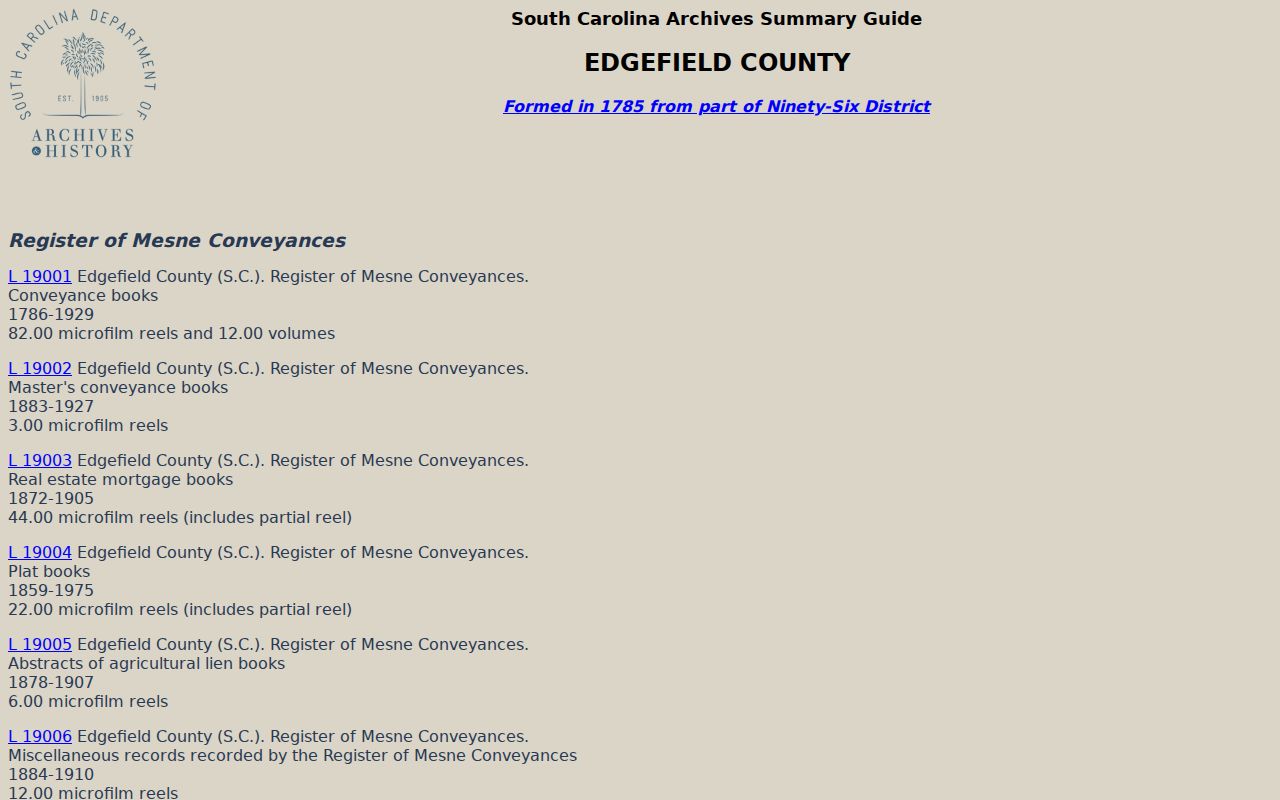
Historic files should be routed by date and record series. County Archives is not a substitute for a live court file or current jail status.
Use the official Edgefield County Archives route, call 803-637-4104, or write to archive@edgefieldcounty.sc.gov when a permanent file may have left the active counter. State Archives may hold a separate series. Give the name, approximate year, court, and known case or book reference to reduce an archival search.
Edgefield Municipal Court Records
Edgefield municipal and Magistrate records must be distinguished. A municipal court can hear assigned city ordinance, traffic, and lower-level state-law matters. Edgefield County Magistrate handles many charges within summary jurisdiction, generally those carrying no more than thirty days or a fine within its authority. More serious criminal cases proceed in General Sessions. Confirm the court named on the citation or notice before searching or paying.
| Court Level | Municipal court for assigned city matters; county Magistrate for its summary jurisdiction; General Sessions for higher charges. |
|---|---|
| Case Types Heard | Ordinance, traffic, and authorized lower-level state offenses, depending on the issuing court. |
| Case Lookup Channel | Issuing court, with Public Index checked where the matter is published. |
| Docket Contents | Case number, charge, events, status, disposition, sentence, and financial entries as available. |
| Copies & Fees | Current municipal copy and certification fees were not located; confirm directly with the holding court. |
Some municipal records appear in Public Index, but not all. An absent result should lead to the issuing court, not to a claim that no case exists.
Edgefield Public Index Record Search
Edgefield Public Index is the main online court channel. Choose Edgefield County, identified as Circuit 11 and county 19, then search by exact case number or party name. Date ranges and spelling variants can narrow a name search. The system requires cookies and JavaScript, and a browser may need to permit pop-ups before case details appear.
A result can include court, case number, filing date, parties, charge descriptions, events, bond, attorneys, disposition, and financial entries. Availability varies. Home addresses stopped displaying for new and existing cases on January 1, 2026. Read the disposition beside each charge rather than relying on a single overall status. The index points to a record, while Clerk Charles L. Reel's office at 129 Courthouse Square provides the route for pleadings and certified copies.
Note: Public Index is a finding aid, and its online docket should not be described as a certified disposition.
Where Edgefield Records End Up
Edgefield town police begin the record trail when they create the report. If county detention receives the person, booking staff create identifiers, charge and custody data, a photograph, and fingerprints. A summary court or General Sessions then records the filed prosecution and outcome. Fingerprints and reported dispositions support the statewide SLED history.
Record flow: Edgefield town police › Edgefield County Courts › South Carolina Law Enforcement Division
The flow explains why a recent event may appear first at the agency or jail and later at the court or SLED. It also explains gaps. SLED reported in 2026 that direct indictments and changed charges do not reliably enter the repository without new prints. Compare the local report, court docket, and CATCH result before deciding whether records agree.
Edgefield General Sessions Records
General Sessions is the criminal side of South Carolina Circuit Court and handles Edgefield cases beyond summary jurisdiction. The Eleventh Judicial Circuit Solicitor prosecutes those matters. The Clerk maintains the neutral court file, while the Solicitor explains charging and diversion decisions. These are different roles, and neither office should be used as a substitute for town-police records.
The Eleventh Circuit General Sessions office describes that prosecution layer.
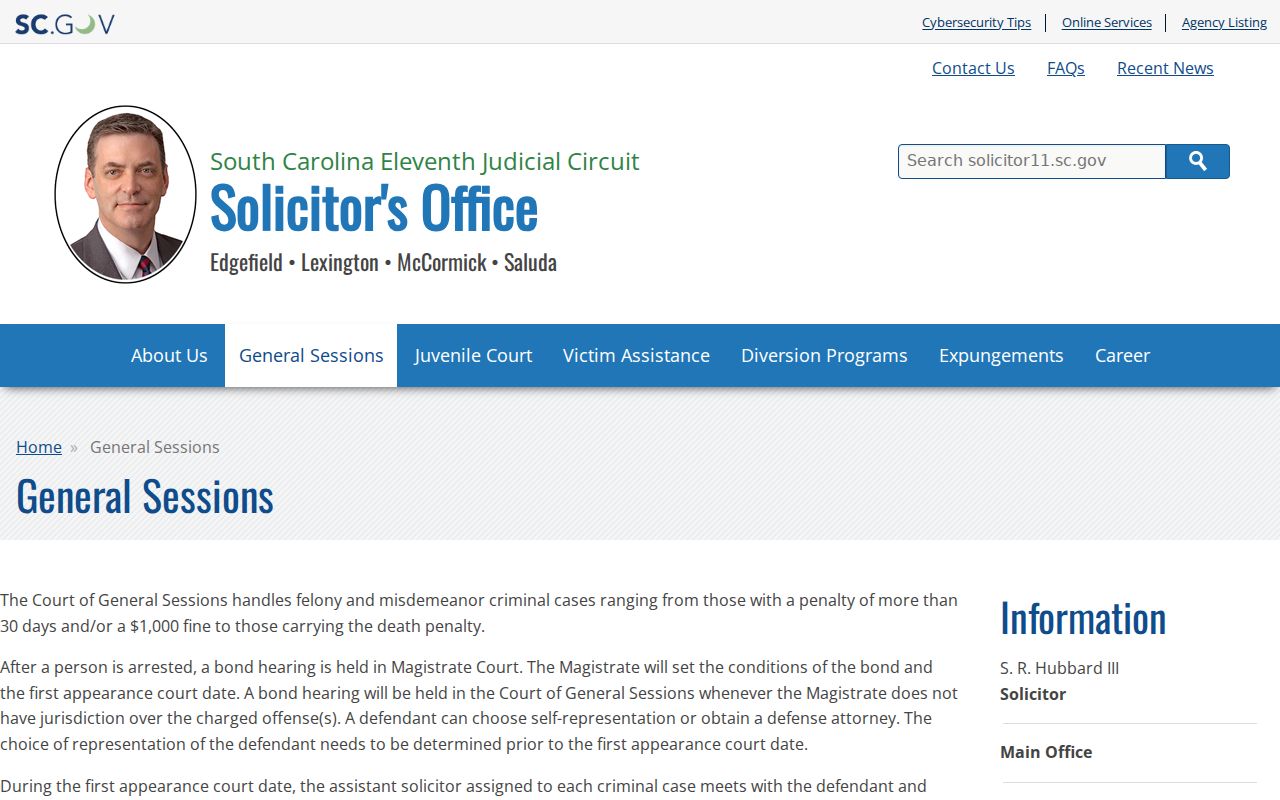
This source helps place a serious Edgefield charge in the correct court path, while the clerk remains the source for certified case records.
A docket may show indictment, bond, attorney entries, hearings, plea or trial events, disposition, and sentence. Diversion can end without a conviction when completed under the applicable program. Always read the filed outcome. The initial booking charge is not the final word.
Verifying Dismissed Edgefield Records
A dismissal does not always become invisible at once. First obtain the disposition and identify whether the charge was dismissed, nolle prossed, acquitted, conditionally discharged, diverted, or ended in conviction. Each outcome has a different legal effect. South Carolina uses expungement for eligible record destruction, and some qualifying non-convictions fall under automatic destruction rules.
For an Edgefield matter, the Eleventh Circuit Solicitor administers applications under the applicable statutes and verifies eligibility with SLED and the proper court. After an order, check the court, creating agency, booking layer where covered, and SLED. If CATCH still shows the item, SLED instructs the person to send a certified true copy of the order, a recently purchased check, and a stamped return envelope to its Expungement Department. Do not infer eligibility from a short online status label.
Processing should be checked office by office. A nonpublic SLED marker may remain where law requires it even after covered public files are removed. If Edgefield Public Index still displays a covered matter, contact the issuing court with the order. If the arresting agency retains public material that the order covers, ask that agency to confirm its processing. The clerk cannot correct every state or police database, and SLED cannot change a file it does not maintain.
Public Access Rules
The South Carolina Freedom of Information Act supplies a formal route for releasable Edgefield public records. Describe the item, date, place, involved agency, incident or case number, desired format, and contact method. Ask for an advance cost estimate and for nonexempt material to be separated from withheld portions. The law does not guarantee that every part is public.
Key Statutes:
South Carolina Freedom of Information Act provides inspection and copy procedures subject to exemptions and reasonable agency rules.
S.C. Code §§23-3-110 and 23-3-120 give SLED criminal-identification duties and require fingerprint record submissions.
S.C. Code §17-1-40 directs destruction of qualifying non-conviction arrest and booking records, with statutory exceptions.
Active investigations, juvenile material, protected identities, medical information, personal data, sealed files, and expunged records may be restricted. FOIA cannot convert SLED's nonpublic repository data into an open town file. Ask the creator for an agency report and the clerk for a certified court record.
For each Edgefield request, retain the office response, estimate, and stated reason for any redaction so later court and repository checks can be compared accurately.